
Argo 3.0 Is Here: Faster Navigation, Clearer Charts, and a Smarter Foundation
Marine navigation has come a long way from paper charts and handheld compasses, but digital tools haven’t always kept pace with what boaters actually need on the water. Too often, navigation apps offer more data than clarity, presenting users with dense, overlapping information when what they need most is a fast, accurate read of their surroundings.
That gap between data and understanding is exactly what Argo was designed to close. Since launching in 2019, the platform has helped hundreds of thousands of boaters across the United States and Canada plan routes, explore new waters, and share local knowledge. Now, with the release of Argo 3.0, the platform takes its most significant step forward yet.
This isn’t a minor update. Argo 3.0 rebuilds the foundation of the app, faster maps, clearer charts, integrated weather data, and an architecture designed to support the next generation of marine navigation tools. Whether you’re a first-time boater learning the basics or a seasoned cruiser covering long distances, the changes in 3.0 are built to make every trip easier to plan and safer to execute.
Why Navigation Needed a Rethink
Digital navigation tools have proliferated over the past decade, and the best of them have made boating genuinely more accessible. But as platforms have added features, many have struggled to keep the user experience simple. Charts become cluttered. Performance lags in complex waterways. Weather data lives in a separate app. Depth information is hard to parse at a glance.
The result is that boaters often spend more time managing their screens than reading the water, which is precisely the opposite of what good navigation software should do.
Argo’s approach has always been to prioritize clarity over complexity. The goal isn’t to pack in every possible data point; it’s to surface the right information at the right moment, in a format that actually supports decision-making. Argo 3.0 is the fullest expression of that philosophy to date.
As founder Jeff Foulk explains: “Boaters don’t need more data — they need clearer information. Argo 3.0 focuses on making navigation faster, simpler, and easier to understand, whether you’re planning a trip at home or navigating on the water.”
A New Base Map, Built From the Ground Up
The centerpiece of Argo 3.0 is a completely rebuilt base map, rearchitected from the ground up to improve both performance and readability in meaningful, everyday ways.
Panning, zooming, switching layers, and building routes are all noticeably faster, even in busy or complex waterways where performance has traditionally degraded. For boaters navigating crowded harbors, shallow coastal areas, or intricate inland waterways, that responsiveness matters. A map that lags or stutters at the wrong moment isn’t just frustrating; it erodes the trust that makes a navigation tool useful in the first place.
The chart layer itself draws from official sources, including NOAA, CHS (Canadian Hydrographic Service), and the U.S. Army Corps of Engineers. These are the same authoritative datasets that professional mariners rely on, now presented in a format optimized for recreational boaters who need accuracy without complexity. Current coverage spans North America, with international waters on the roadmap for later this year, a meaningful expansion for cruisers who venture beyond U.S. and Canadian boundaries.
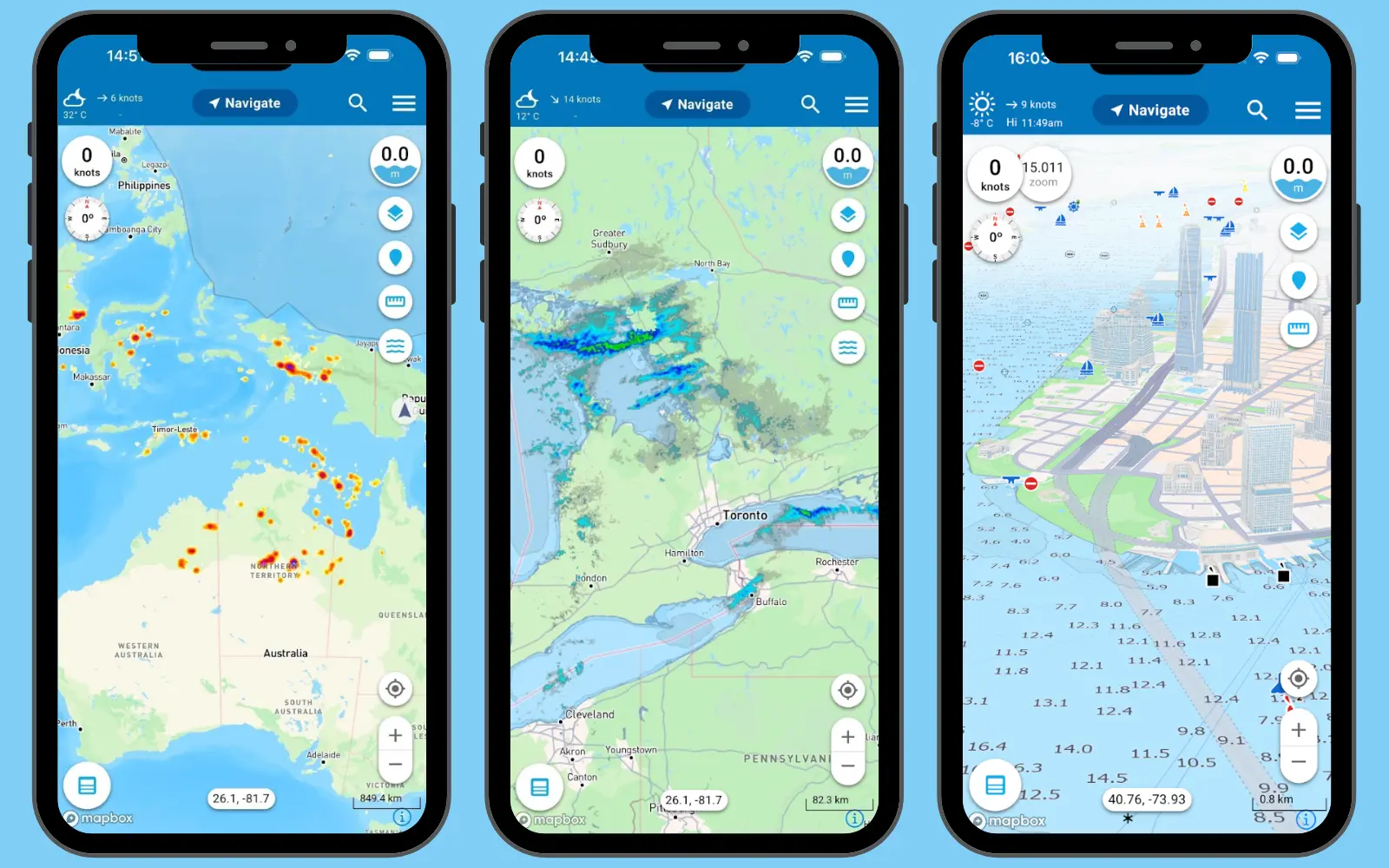
Dynamic depth contours and depth shading have also been introduced to give boaters a clearer spatial sense of the water column beneath them. Rather than relying solely on spot soundings, the new chart presentation makes it easier to understand the shape of the bottom at a glance, particularly useful when navigating unfamiliar areas or adjusting course to avoid shallow spots.
Beyond the immediate user-facing improvements, the new base map is architecturally significant. It provides the infrastructure needed to support additional data layers, more sophisticated routing tools, and future capabilities that weren’t possible on the previous platform. In that sense, the new base map isn’t just a better map, it’s a better foundation.
Wind Data, Integrated Where You Actually Need It
One of the most practical additions in Argo 3.0 is integrated wind data, displayed directly within the navigation chart. For boaters, wind is one of the most consequential environmental variables, affecting everything from route planning and departure timing to real-time course adjustments and anchoring decisions. Having that information overlaid on the same chart showing your route, nearby waterways, and surrounding terrain is a fundamentally different experience than toggling between apps.
With Argo 3.0, wind conditions appear in context. You can see how the wind is tracking relative to your planned route, identify areas where conditions might be more exposed, and make informed decisions without ever leaving the chart view. It’s a small workflow change that adds up quickly over the course of a day on the water.
Wind is also just the beginning. The new platform architecture is specifically designed to support additional weather layers in the near future, including weather radar, lightning, currents, water temperature, and wave data. Each of these layers presents its own design challenges, marine weather data is complex, and presenting it in a way that aids rather than overwhelms requires careful thought about what to show, when to show it, and how to keep the chart readable.
Argo’s approach is to integrate these layers directly into the chart experience, rather than treating weather as a separate module. The goal is to make it possible for a boater to look at a single screen and have a clear, complete picture of their route and the conditions they’ll encounter along the way.
Dynamic Depth Numbers
Depth awareness is one of the most fundamental elements of safe boating, and one of the areas where chart readability has historically left the most room for improvement. Depth numbers that rotate with the map, cluster in busy areas, or become difficult to read at certain zoom levels create friction at exactly the moment when clarity matters most.
Argo 3.0 addresses this with dynamic depth numbers that remain upright as the map moves and rotates, maintaining consistent legibility regardless of orientation. Users can also adjust the density of depth labels to suit their preferences and the complexity of the area they’re navigating, showing more detail in shallow or intricate waterways, and a cleaner view in open water where fewer labels are needed.
It’s a refinement that might seem small in isolation, but for anyone who’s tried to navigate a shallow inlet or a tidal flat under time pressure, the difference between a readable depth chart and a cluttered one is anything but trivial.
What’s Coming Next
The rebuilt platform establishes the technical foundation for a new generation of features that will continue to roll out in the months ahead.
On the weather side, the near-term roadmap includes the additional layers mentioned above… weather radar, lightning, currents, water temperature, and waves, each integrated directly into the chart view in a way that keeps the experience coherent and actionable. To help with planning, a 72-hour slider will be added.
Bathymetry is another area of active development. Expanded bottom composition data will give boaters richer information about what lies beneath the surface, useful not just for navigation but for anchoring, fishing, and exploring new areas with confidence.
Intelligent routing tools are also on the horizon. Argo already offers autorouting across North America, but future updates aim to incorporate more variables into the routing engine, including weather conditions, tidal data, and user preferences, to surface safer and more efficient routes automatically.
The through-line across all of these developments is the same principle that drives the 3.0 release: the most useful navigation tool isn’t the one with the most features, but the one that presents the right information in the clearest possible way, at exactly the moment you need it.
Getting Started with Argo 3.0
Argo 3.0 is now available across all supported platforms: iOS, Android, and desktop web browsers. Existing users will receive the update automatically; new users can download the app or access it at argonav.io.
The platform includes both free and premium features. Premium access, which includes full chart coverage, advanced routing, offline access, 7-day marine forecasts, and more, is available for $39.99 per year, making it one of the more accessible options in the marine navigation space.
For boaters who’ve been looking for a platform that takes clarity as seriously as capability, Argo 3.0 is worth a close look.