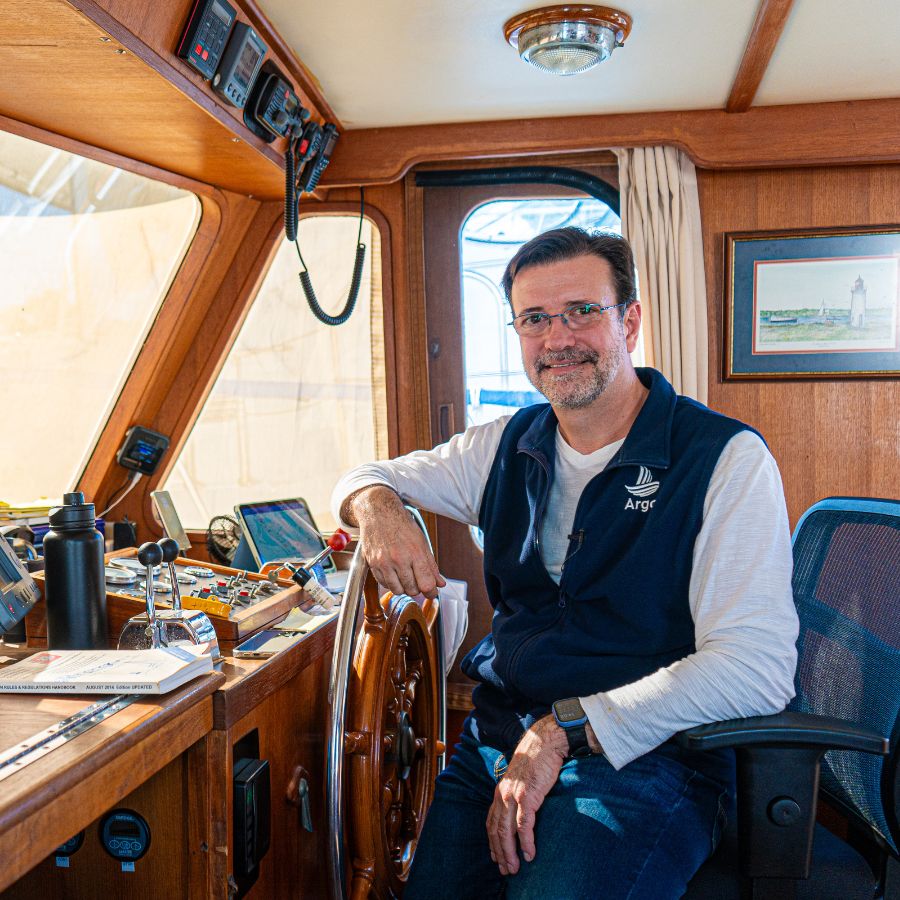
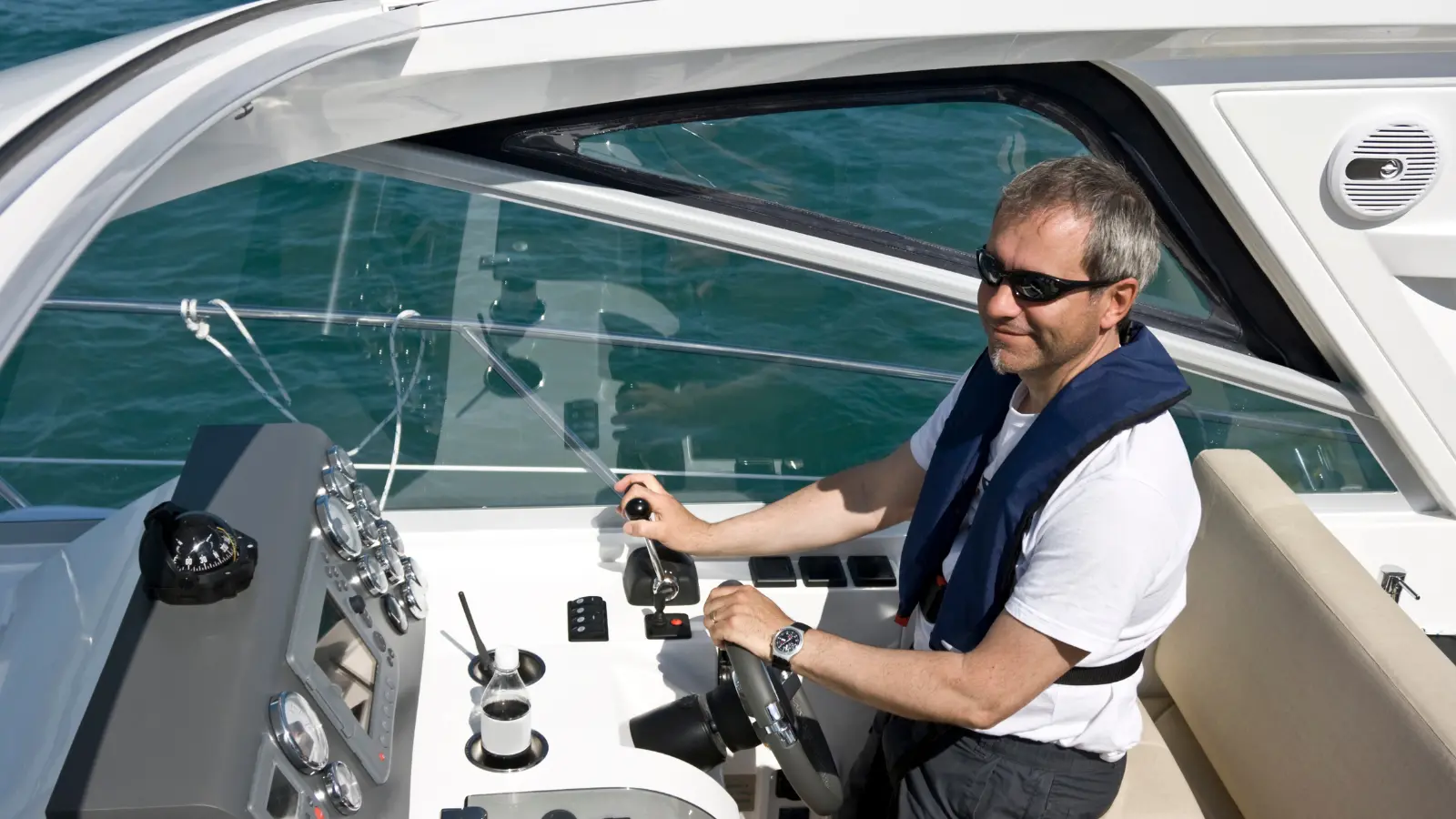
A boat’s helm station can look deceptively familiar. There is a steering wheel, a throttle and shifter, and perhaps a comfortable seat that looks suspiciously like the driver’s seat of a car. If you have spent years driving but never put in time at the helm, it is tempting to assume that you already understand the basic idea.
You don’t.
Boats operate in a fluid environment, and the way they respond to the controls takes time to learn. The steering wheel may be familiar, but the machine underneath it is not. You won’t really understand your boat until you’ve spent some time with your hands on the controls and learned how it responds to throttle, steering, wind, current, waves, and momentum. That isn’t meant to frighten you away from boating. It is meant to encourage the appropriate amount of respect.
You don’t need to know everything about boating before you leave the dock. You do need to know enough to recognize what you don’t know, and enough to know when a situation is asking more of you than you are prepared to give.
For a deeper look at why boats demand a different mindset than cars, see my previous blog From the Driver’s Seat to Helm: Why Boats Demand Respect. You may also want to read Top 10 Annoying (and Often Dangerous) Boating Mistakes, which looks at some of the common assumptions and habits that can get otherwise competent people into trouble on the water.
Get educated before you get underway
There are two kinds of basic boating education everyone should think about before leaving the dock for the first time: the education you are required to have and the education you ought to have. In a safety-first workflow, it is hard to argue that you’re prepared until you’ve done both.
In the United States, boating education requirements are established at the state level and vary considerably. Some states require education for certain ages, vessel types, or operators, while others have broader requirements. Requirements can also change, so check the current rules for the state or states where you will be operating. The U.S. Coast Guard maintains a current state-by-state summary, including information about reciprocity between states. A NASBLA-approved boating safety course is a good place to start, even when your state does not require one.
Canada takes a different approach. Anyone operating a power-driven pleasure craft generally needs proof of competency. For most recreational boaters, that means a Pleasure Craft Operator Card (PCOC) obtained by passing an accredited test. Transport Canada strongly recommends taking a boating safety course rather than simply challenging the test.
These requirements are important, but don’t confuse a legal credential with practical competence. A boating safety course can teach you the Navigation Rules, required equipment, aids to navigation, emergency procedures, and the responsibilities of an operator. It cannot teach you how your particular boat will behave when you put it into reverse with a crosswind pushing you toward a dock. For that, you need experience.
Learn to handle the boat
If you are new to boating, get some hands-on instruction before you decide you are ready to take friends and family out on your own. Professional instruction is ideal and having the instructor work with you on your own boat is even better. You want to learn the behavior of the vessel you will actually be responsible for, not merely learn general principles on somebody else’s boat.
Spend time in open water where you have room to make mistakes. Learn how quickly the boat accelerates and how long it takes to stop. Learn what happens when you shift into reverse, how much steering authority you have at idle and at speed, and how wind and current affect the boat when you are moving slowly—or not moving at all. Anchor some buoys (boat fenders work great for this) nearby, then practice maneuvering around them as though docking on imaginary lines between and around them. Once you have mastered the imaginary dock, head back and practice real docking. Coming alongside a dock or into a slip is one of the best places to discover whether you actually understand the boat and one of the worst places to discover it for the first time.
Docking is a maneuver, not a test of bravery. If an approach isn’t working, abort and re-approach. If the wind has you uncomfortable, wait. If you need somebody on the dock to take a line, ask them. The dock isn’t going anywhere, so never approach it any faster than you are willing to hit it.
Pro Tip: When docking, you have the greatest control whenever you are approaching into the greater force. So if the wind is stronger than the current, dock into the wind. If the reverse is true, dock into the current. If you’re unsure which is stronger, defer to the current unless proven otherwise.
Once you have the basic maneuvers down, keep practicing. Take the boat out in conditions that give you plenty of room to make mistakes, then gradually let experience introduce more wind, more current, tighter spaces, and more complicated situations as your skills improve. Learn what the vessel does before you have to find out next to a piling, a dock, or another boat.
There is no shortcut to developing a feel for a boat. Confidence comes from repetition, not optimism. You don’t need to prove anything to anyone, and there is no requirement that every outing become a story worth telling. The objective is to become sufficiently familiar with the boat that your reactions are deliberate and you recognize a developing problem while you still have time to respond.
Know your boat
Before you leave the dock, you should know your boat well enough that an emergency doesn’t become an archaeological expedition through your own lockers looking for safety gear. You should know where the life jackets are and how to put them on, where the fire extinguishers are and how to use them, and where the battery switches, bilge pumps, seacocks, fuel shutoffs, and engine controls are located. You should know how to shut the engine down and what you would do if it overheats, if the steering fails, if you lose electrical power, or if the engine simply refuses to start.
You should know where the anchor is, how to deploy it, and how much rode you have. You should know how much fuel you have and, more importantly, how far that fuel will realistically take you; a fuel gauge is not a range calculation. You should also know your boat’s draft, because the bottom has no interest in your confidence, your navigation app, or how much you paid for the boat. Understand squat and how the boat maneuvers in shallow water. Know how much water you need beneath you, understand the limitations of your chart data, and leave yourself a reasonable margin.
Knowing your boat is not memorizing its specifications. It is knowing what you will do when something doesn’t go according to plan.
Know the water
You should never make your first acquaintance with a waterway while traveling through it at cruising speed. Study the charts in Argo before you leave and develop at least a basic understanding of the route you intend to travel. Know where the channels are, where the shallow water is, and where the hazards are. Plot a route for your trip to make sure you are using the best, safest route to get to your destination. Look for bridges, rocks, wrecks, shoals, restricted areas, strong currents, and other conditions that could affect your trip.
Pay particular attention to anything that matters to your boat. A route that is perfectly reasonable for a boat drawing three feet may be a terrible route for one drawing five. Electronic navigation is a powerful tool, but a route on a screen is not a guarantee that the route is appropriate for your vessel. The person at the helm remains responsible for understanding where the boat is going and whether it is safe to go there. If you are using an Argo autoroute, make sure you study it for hazards or errors. Situational Awareness is cultivated. It isn’t automatic.
Respect the weather
Weather is also a vital part of the operating environment to understand, and a calm, sunny morning at the dock tells you very little about what conditions might be waiting for you later in the day. Before you leave, look at the forecasted wind, gusts, thunderstorms, visibility, waves, tide, current, and any watches, warnings, or advisories that may affect your trip. Then make the less obvious calculation: What does that mean for my cruising plans?
A 15-knot wind may be an enjoyable afternoon for an experienced operator on a heavy cruising boat and an entirely different proposition for a novice in a small open boat. A thunderstorm that looks distant on the forecast can become considerably less distant when you’re sitting in a boat with nowhere to hide. Good seamanship includes knowing when not to go, and there is no shame in postponing a trip because the conditions exceed your experience or the capabilities of your boat. Recognizing that fact is one of the first signs that you are becoming a competent boater.
Safety is more than equipment
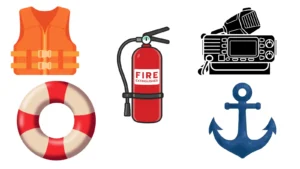
Every boat should carry the safety equipment required for its size, type, and operating area. That commonly includes properly sized personal flotation devices, throwable flotation, fire extinguishers, sound-producing devices, navigation lights, visual distress signals where required, an anchor and rode, and appropriate means of communication. The regulations are the starting point, not the finish line.
Safety equipment needs to be accessible, maintained, and familiar. A life jacket buried underneath six backpacks, a pile of beach towels, and behind your scuba gear is technically aboard, but it isn’t particularly useful when somebody is already in the water. The same principle applies to your communications equipment: know how to use the VHF, know how to hail another vessel, and know how to make a distress call. Think about the things that can realistically go wrong and ask yourself whether you would know what to do if one of them happened right now.
You don’t need to have a detailed response prepared for every conceivable disaster. You do need to have thought about the common ones. Engine failure, fire, flooding, loss of steering, a person overboard, rapidly deteriorating weather, and a medical emergency are all situations in which having thought through the first few steps beforehand can make an enormous difference.
That is what safety equipment is really for. It is not a collection of objects required by a regulation; it is the means by which you turn an unexpected crisis into a manageable problem.
Fire
A word about every mariner’s greatest fear aboard. An out-of-control fire on a boat presents a grim choice: drowning or burning alive. If you are prepared for nothing else, be prepared for how to fight fire and to know when to stop fighting and get everybody in the water in a life jacket. If you have a life raft, consider having someone deploy it while you’re still fighting the fire, rather than waiting until you need it. Shut down the engines and fuel sources if you can do so safely. Turn off blowers. Disconnect electrical power where appropriate. Close hatches you can access. Starve the flames of oxygen and fuel. Most of all, know when you’re beat, and get off the boat.
Take responsibility for the people aboard
Your passengers may know nothing about boats, and that is perfectly fine. They should, however, know enough to be useful rather than becoming additional problems when something goes wrong. Before leaving the dock, show them where the life jackets are and how to put them on, show them the fire extinguishers, tell them what to do if someone falls overboard, and explain where you want them to sit or stand while underway.
If you are the only person aboard who knows how to operate the boat, consider teaching at least one other person how to start it, steer it, use the radio, and summon help. You don’t want your entire emergency plan to depend on one person remaining conscious and functional.
You should also tell someone ashore where you are going and when you expect to return. For a simple afternoon outing, that may be nothing more than a text message. For a longer trip, provide a proper plan with your route, destination, vessel information, people aboard, and expected arrival time to a responsible party ashore. The U.S. Coast Guard calls it “filing a float plan” (and provides a form for it available online and in Argo), while Transport Canada specifically recommends “filing a trip plan.” They are the same thing—tell someone your plans and when to assemble the posse. The point isn’t paperwork. The point is that if you fail to come home, somebody knows where and when to start looking for you.
The beer cooler can wait
Boating has acquired a cultural reputation as an excuse to imbibe. The image is familiar: sunny day, boat full of friends, cooler full of beer. There is nothing inherently wrong with enjoying a drink while relaxing aboard a boat when the circumstances and local laws permit it. There is, however, a very important distinction between being a passenger and being the person responsible for operating the vessel.
If you are at the helm, you are responsible for the lives aboard your boat and for the people sharing the waterway with you. The gravity of that responsibility should dictate your behavior. Alcohol impairs judgment, coordination, balance, vision, and reaction time, while the marine environment can compound those effects through sun, heat, wind, motion, vibration, and fatigue. The U.S. Coast Guard identifies alcohol as the leading known contributing factor in fatal recreational boating incidents; in its 2024 statistics, alcohol was listed as a contributing factor in 20% of deaths where the primary cause was known.
Boating under the influence is illegal, just as driving a car under the influence is (usually with the same penalties when caught), and the fact that you are on the water does not somehow make the consequences less serious. More importantly, you don’t need to be visibly drunk to have your judgment impaired at precisely the wrong moment. The boat operator has a duty to exercise good judgment for everyone aboard, and that means exercising reasonable restraint around the beer cooler until the cruise is over.
If you are a passenger, enjoy yourself responsibly. If you are the operator (or even backup operator), stay sober and stay focused on the job. You can have the beer when you get back to the dock.
Learn the Rules of the Road
You don’t need to memorize every provision of the Navigation Rules before your first outing, but you do need to understand the basics. You should know what stand-on and give-way mean, understand meeting, crossing, and overtaking situations, recognize basic navigation lights and channel markers, and understand safe speed, restricted and narrow channels, and common sound signals.
These aren’t obscure regulations designed to make boating complicated. They are the rules that allow two people who have never met to operate boats in the same piece of water without having to guess what the other person intends to do. Predictability is one of the foundations of safe navigation.
The U.S. Coast Guard publishes the Navigation Rules and Regulations Handbook, commonly called the Rules of the Road. It contains the International and U.S. Inland Navigation Rules and is an essential reference for anyone learning to operate a boat. The current publication is available on the Coast Guard’s Rules of the Road page, and you can also find the Rules of the Road PDF in Argo’s Boat Safety & Education area.
Read it. You don’t have to memorize the entire thing, but you should understand enough of it that you aren’t learning the rules for the first time while another boat is bearing down on you.
The goal is good judgment
Nobody becomes a competent boater by reading one article, taking one course, or passing one test. Education gives you a foundation, instruction teaches you how to handle the boat, and experience teaches you how those things come together when conditions aren’t quite what you expected.
The real goal is not to become the person who can handle anything the water throws at them. It is to become the person who recognizes when a situation is beyond their experience, when the weather has turned against them, when an approach isn’t working, or when something simply doesn’t feel right. Good judgment means having the confidence to slow down, turn around, wait, ask for help, abort and re-approach, or just stay on the dock and party without cranking up the engine.
The person at the helm is ultimately responsible for making those decisions. The boat doesn’t know whether you are experienced. The chart doesn’t care whether you understand what it is showing you. The weather forecast doesn’t suddenly become mild just because you invited fifteen people aboard (please do not exceed the rated passenger capacity of your vessel if one is posted). Your passengers are depending on you to put all of that information together and decide what is safe.
Boating becomes much more enjoyable once you stop trying to prove that you can handle everything the water throws at you. Learn your boat, learn the rules, get some instruction, pay attention, and give yourself enough margin that you have somewhere to go when things don’t work out exactly as planned.
Then, when you’re ready, drop lines and get underway.