

“Can I offer you a beer?” I asked.
He gratefully accepted, and we sat there in the cockpit of my boat, quaffing and laughing about the vagaries of boat ownership. Half an hour later, beers drained, he said, “I better go back to my boat and watch it break.”
I laughed, but there wasn’t any real hyperbole in what he said. I laughed because it was true.
Boat ownership, it is said, is the art of doing boat maintenance in exotic locations. Some boat owners, however, don’t seem to know that. They buy into the dream, enjoy the boat for a while, and then move on. The boat goes up for sale, and it may need a whole lot of work that even the owner doesn’t understand needs doing.
It looks good in the pictures. You make an offer on this “turnkey” beauty, and it’s accepted. You schedule a survey, and the veneer starts to rub off as the findings add up. The shaft packing needs replacing, the cutless bearings are worn, hoses and clamps are past their prime, belts are overdue, batteries will not hold a charge, and engine maintenance has been put off. The paint and brightwork need attention. Individually, none of these things may be particularly alarming. Together, they represent a pattern of neglect, intentional or not, a substantial maintenance backlog, and a substantial bill.
The boat may well be fundamentally sound and represent a perfectly reasonable purchase at the right price. The question is whether the price reflects the boat you’re actually buying, rather than the boat the listing led you to expect. This is where deferred maintenance becomes a buyer’s problem, because the cost of making a boat right doesn’t disappear just because the previous owner didn’t pay it. So how do you put a value on a boat that has been allowed to slide, and when does deferred maintenance rise to the level of neglect? For a buyer, the answers are worth real money.
The problem with “turnkey”
The word turnkey gets used rather freely in boat listings, along with well-maintained, ready to cruise, and just needs a little TLC. These descriptions can mean very different things to different people. One owner might consider a boat turnkey because the engines start, the transmissions engage, and the refrigerator keeps the beer cold. Another might reserve the term for a vessel whose systems have been maintained, whose known deficiencies have been addressed, and whose next owner can reasonably expect to use it without first spending weeks in a boatyard.
Neither photographs nor a successful engine start can establish the difference. A boat can be clean, attractive, and operational while carrying years of accumulated maintenance deferral, much of which isn’t apparent until someone looks closely at the machinery, running gear, electrical system, plumbing, and other components that don’t feature prominently in the listing photographs.
The seller may not be deliberately misleading anyone. Owners develop their own sense of what is normal for their boat, and familiarity can make deficiencies seem less significant than they would to a prospective buyer. A hose that has looked old for years becomes part of the scenery, a persistent leak becomes something to keep an eye on, and an overdue service gets postponed until next season. Eventually, the boat is offered for sale, and the owner describes it in terms of how it operates rather than what it will take to keep it operating reliably. The buyer, meanwhile, may reasonably interpret turnkey to mean that routine maintenance has been kept reasonably current. When the survey reveals otherwise, the two parties may have very different ideas about the value of the boat.
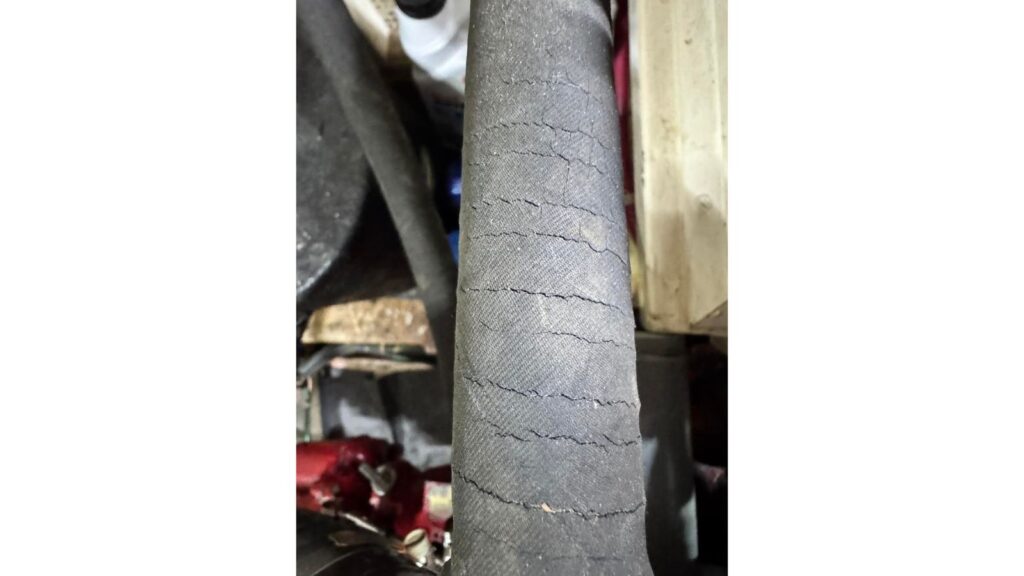
Dry-rotted hoses need to be considered “end of life” and replaced as a priority.
When deferred maintenance becomes neglect
Every boat has maintenance requirements, and no boat of any meaningful age can be expected to pass an unlimited inspection with nothing needing attention. Components wear out, materials deteriorate, and even conscientious owners must decide which jobs need doing now and which can reasonably wait. The mere existence of deferred maintenance isn’t evidence of neglect; the distinction lies in the pattern and its consequences.
Seasonal ownership introduces another version of the problem. Winterizing a boat and laying it up properly for a few months is part of responsible ownership in much of the country. The trouble begins when a boat that was meant to be out of the water for one winter stays there for another, and then another. We started out as seasonal boaters in Maine and made a pact: the first summer the boat stayed out of the water because we had decided to concentrate on land life for a season, we’d sell it. We knew how easily a temporary decision could become a habit. Boats are meant to be used, and boats that sit tend to deteriorate. The damage isn’t always dramatic or immediately visible, but moisture, neglected systems, aging batteries, and the absence of regular operation can take their toll surprisingly quickly. Two dry seasons become three, and before long the owner is facing a boat that needs more work than it’s worth.
A minor leak that has been identified, monitored, and scheduled for repair is different from one that has been allowed to damage the surrounding structure. Replacing a battery that has reached the end of its useful life is ordinary maintenance, while discovering that an entire bank of batteries has deteriorated alongside neglected charging equipment raises a broader question about how the electrical system has been cared for. The same reasoning applies to shaft packing, cutless bearings, outdrive bellows, transmission and lower unit lubrication, hoses, clamps, belts, engine adjustments, and the many other items that demand attention as a boat ages. Each has its own service life, maintenance requirements, and consequences of failure, but when a survey identifies a long list of overdue items across unrelated systems, the accumulation tells a story that no individual item could tell on its own.
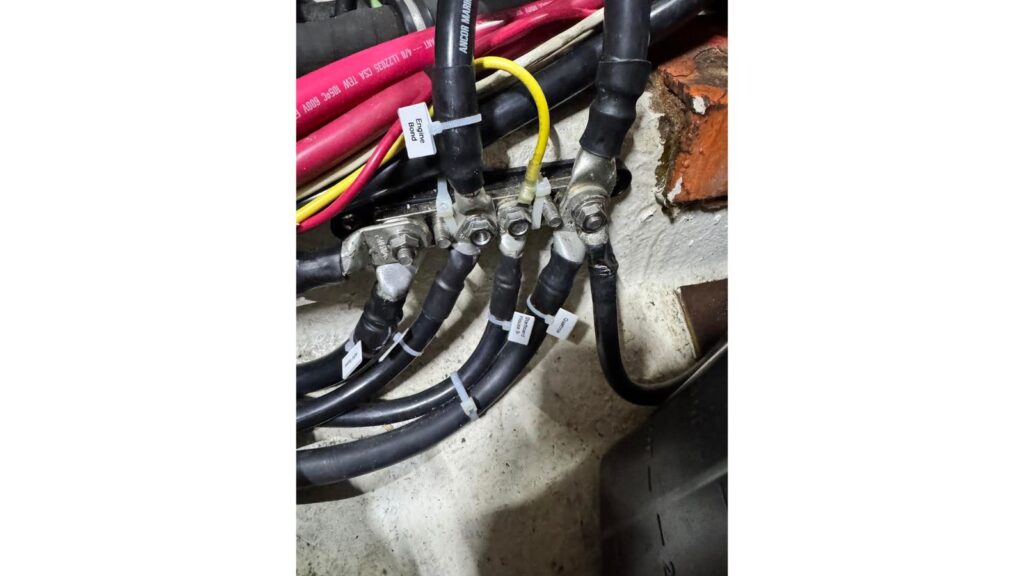
Wiring aboard should be well labeled, well supported, and easy to follow, such as on this DC negative bus bar.
At some point, the question ceases to be whether a particular job could reasonably have waited. It becomes whether the owner has been maintaining the boat at all, or merely operating it while maintenance obligations are ignored. That is when deferred maintenance begins to look like neglect. For a prospective buyer, the distinction isn’t primarily moral; it is financial. Whether the previous owner lacked the money, time, knowledge, or inclination to maintain the vessel doesn’t change the work required to bring it up to the expected standard, nor does it change who will have to pay for that work after the sale.
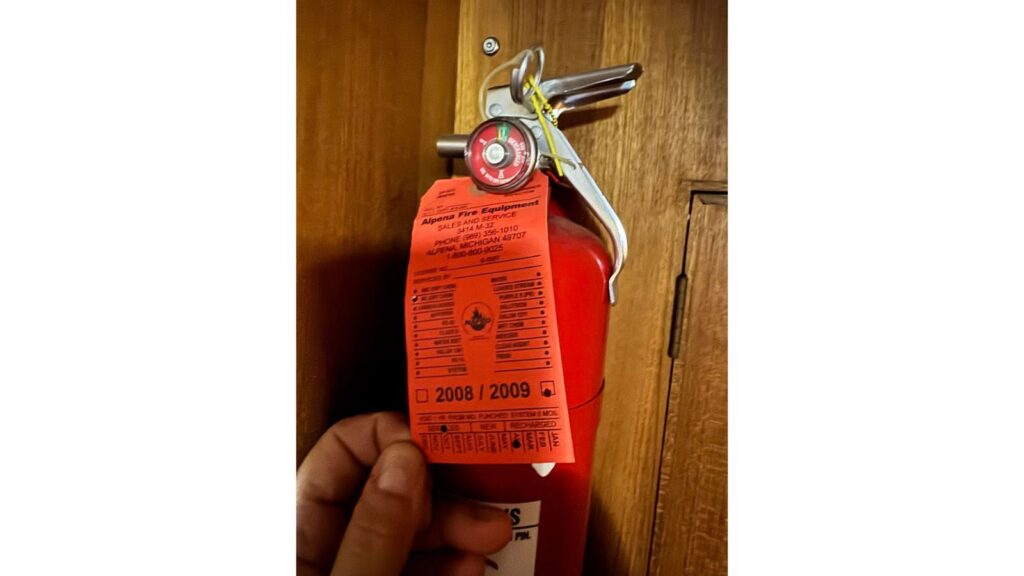
Out-of-date fire extinguisher tag: these should be inspected and weighed annually if they are not maintenance-free with an expiration date. A missed year or two is no big deal, but when inspections have been deferred for over a decade, that quickly becomes a red flag that should make a savvy buyer wonder what else might be deferred.
Put a price on what hasn’t been done
I approach this problem by taking the original asking price and the condition represented in the listing at face value. If the seller advertises a boat as turnkey at $100,000, I start by asking what that price implies: what would I expect to receive for $100,000 if the boat really were turnkey? I then estimate the reasonable cost of correcting the deferred maintenance identified during vessel survey and subtract that amount from the asking price. The result isn’t an appraisal, but it is a useful way to bring some financial reality into the negotiation.
Consider a hypothetical cruising boat advertised for $100,000. A survey and follow-up inspections identify worn cutless bearings and overdue shaft packing, aging hoses and belts, batteries approaching the end of their useful lives, overdue engine service, and deteriorated paint and brightwork. The boat runs well and completes a satisfactory sea trial, but the work needed to bring it up to the condition implied by the listing is estimated at $14,500. An additional $3,000 is allowed for incidental findings that commonly emerge as maintenance work gets underway, bringing the total anticipated expenditure to $17,500. Subtracting that from the asking price produces an adjusted figure of $82,500.
That doesn’t establish that the boat is worth precisely $82,500, but it gives the buyer a defensible starting point for negotiations. If a comparable boat in genuinely turnkey condition is available for around $100,000, why would it make sense to pay that same amount for a boat that requires another $17,500 in work? The figures here are illustrative, not a universal estimate; actual costs depend on the vessel, the scope of the work, local labor rates, and access to the components involved.
There are qualifications. The estimates must be realistic, preferably based on actual yard quotes or informed assessments rather than optimistic guesses about parts prices and do-it-yourself labor. Cosmetic work should also be treated consistently with the condition represented in the listing. If the seller has already priced the boat to reflect faded paint and weathered brightwork, for example, the buyer shouldn’t deduct the full cost of repainting it as though the boat had been advertised in pristine condition. The objective is to account for the difference between what is represented and what is actually being offered, not to charge the seller twice for the same deficiency.
The calculation doesn’t guarantee that the seller will accept the resulting offer, or that the market will agree with the buyer’s valuation. It does something more useful: it separates the emotional appeal of the boat from the economic consequences of its condition and provides a rational basis for deciding what to offer.
Why published values don’t tell the whole story
Boat valuation guides are useful reference points, but they cannot fully account for the condition of an individual vessel. They may help establish a baseline for a particular make, model, year, and configuration, yet the difference between a well-maintained example and one with years of accumulated maintenance can be difficult to express through a published figure alone.
Consider the treatment of upgrades. A new suite of Garmin electronics is easy to identify, photograph, and advertise. It may improve the boat’s capabilities and appeal, even if the market doesn’t recognize the entire purchase price as added resale value. Maintenance is less visible. New hoses, serviceable running gear, properly maintained engines, and current batteries may not add an identifiable premium to a valuation guide, but they preserve the condition and functionality for which a buyer is already paying. The reverse is also true: an otherwise comparable boat with overdue maintenance may appear to have the same guide value as one whose owner has kept everything current, even though the buyer will eventually encounter the accumulated liability in yard invoices, replacement parts, labor, and time spent getting the boat where it should have been at the time of purchase.
This is why a published valuation should be treated as a reference rather than a verdict. A boat’s value isn’t determined solely by what works today; it is also affected by the condition in which it has been maintained, the work required to sustain that condition, and the uncertainty surrounding components whose history or current state is unclear. Maintenance doesn’t necessarily add value dollar for dollar, just as a new electronics package doesn’t necessarily increase resale value by its full retail cost. Much of the purpose of maintenance is to preserve value and prevent deterioration rather than to create an upgrade premium. Nevertheless, a boat with a substantial maintenance backlog should not automatically command the same price as an otherwise comparable boat that has been properly maintained. The buyer needs to recognize the difference, even when the valuation guide doesn’t make it explicit.
The cost of what you don’t know
The calculation becomes more complicated when the condition of major systems cannot be established with reasonable confidence. A list of known deficiencies can be priced, at least approximately, but an unresolved question about an engine, transmission, or other major component is different because the potential expense may be far greater than the cost of the routine work already identified. A pre-purchase survey, sea trial, maintenance records, and appropriate engine or systems inspections help establish what the buyer is actually acquiring. If the evidence raises questions about a major component, further testing may be warranted; where uncertainty cannot be resolved, the buyer must decide whether to negotiate a price that reflects the risk, make the purchase conditional on additional inspection, or walk away.
A successful sea trial doesn’t prove that every system is in good condition, but it does provide useful evidence about the vessel’s performance under operating conditions. Conversely, the inability to conduct a meaningful sea trial leaves questions unanswered. A buyer shouldn’t automatically assume that an untested engine or transmission is defective, but neither should the buyer value it as though its condition has been established. A maintenance backlog may therefore represent not only the cost of work that is already known to be necessary, but also uncertainty about whether other costly problems exist. That uncertainty deserves consideration in the purchase decision, independently of the estimates for routine maintenance.
Buy the boat that’s there
An older boat that needs a great deal of work can still be a good purchase. The asking price may already reflect its condition, the buyer may have the skills and resources to do the work, or the vessel may offer enough advantages to justify the investment. Some buyers actively prefer a project. The important thing is to recognize that it is a project and to pay accordingly. The trouble starts when a boat is priced as though its maintenance has been kept current, while the buyer is expected to absorb the cost of bringing it up to that standard. A seller may genuinely believe the boat is turnkey because it has served them well for years, but that doesn’t make the description a reliable assessment of the work the next owner will face.
When evaluating a used boat, start with the asking price and the condition the seller represents. Establish the vessel’s actual condition, identify the outstanding work, and obtain realistic estimates for correcting it. Separate routine maintenance from optional improvements, account for significant uncertainties, and compare the result with other boats that are genuinely comparable in condition. Then decide whether the price makes sense. No boat will be perfect, and no inspection can eliminate every uncertainty. The objective isn’t to punish an owner for the inevitable wear and tear of boat ownership, or to insist that every aging component be replaced before a sale; it is to recognize when the accumulated cost of deferred work materially changes the value of the vessel being offered.
A buyer doesn’t need to prove that the seller has been negligent. The buyer needs to understand the boat’s condition, the obligations that come with it, and the price that makes the purchase rational. When you buy a boat, you inherit its maintenance history, whether that history is documented in service records or written in the things that haven’t been done. The savvy buyer will make sure the price reflects the vessel reality whether or not it agrees with the seller’s narrative. Caveat emptor.